Cyber-Trafficking: The Global Crisis Hidden in Plain Sight
By Eason Yang
The Promise of a Better Life
The promise was simple: a high-paying data entry job overseas, an opportunity to escape unemployment and create a better future. For Imtiyaz Babu, a resident of the Delhi-Bhawana community, it seemed like a once-in-a-lifetime chance. However, it turned into a nightmare.
Babu’s cyber trafficking route was intricate—first from Kolkata to Bangkok, then illegally into Myawaddy, Myanmar. There, a notorious scam den called KK Park held him. Traffickers beat him and forced him at gunpoint to carry out online scams targeting unsuspecting American citizens. He is one of many Indian citizens trapped in what is called “cyber slavery.”

Rescue and Repatriation
His ordeal ended on October 22, 2025, when the Myanmar military raided his residence. The victim was transferred to a humanitarian camp and returned home on November 19 with the assistance of the Indian Embassy. But for Babu, returning home meant the fight for justice had just begun. His formal complaint prompted an investigation by the Delhi Police Intelligence Fusion and Strategic Operations (IFSO) unit. This led to the arrest of two key recruiters: Danish Raja and Hash.
When Victims Become Perpetrators
Raja’s case is particularly disturbing. He had himself been deported from Myanmar in March 2025. However, he allegedly continued recruiting jobless youths for the very same syndicate that had once held him. “Admitted to maintaining links with Myanmar-based scam operators,” police stated, revealing how victims can become perpetrators, whether through coercion, desperation, or profit.
The Africa Connection: Ghana’s Crackdown
Across Africa, similar operations are being exposed.
In Ghana, in March 2026, a joint operation by the Ghana Police Service and Ghana Immigration Service arrested 12 Nigerian nationals suspected of organized cyber fraud and human trafficking-related activities. The raid, led by Deputy Superintendent of Police Malaika Jibril Alhassan and Superintendent Francis Baidoo, uncovered 25 laptop computers and seven mobile phones—tools of a trade designed to defraud victims worldwide.
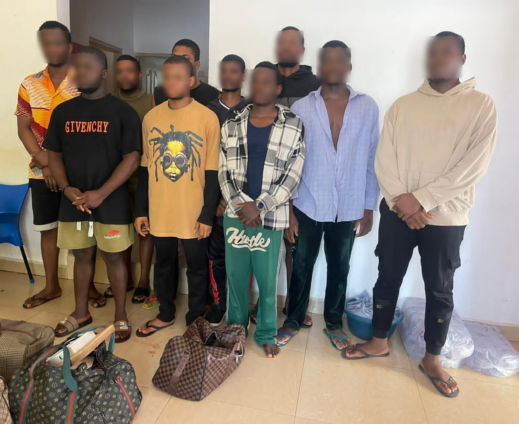
Dogs Against Officers
When officers attempted to execute the operation, suspects released German Shepherd dogs against them, underscoring the organized and violent nature of these networks.
“The operation demonstrates the growing nexus between cyber trafficking networks and transnational migration activities,” Ghana Police stated. Six other suspected Nigerian nationals remain at large.
Southeast Asia: A Regional Crisis
In Southeast Asia, the crisis has reached such proportions that nations are now publicly confronting each other. On February 17-18, 2026, Thai authorities arrested 12 people who had escaped from Cambodia: six Vietnamese nationals who claimed a Chinese gang lured them into forced labour and seized their documents, and five Chinese and one Cambodian national caught with 270 mobile phones, multiple SIM cards, and various foreign currencies—evidence directly linking them to transnational cybercrime.
The “State Zone” Problem
The Royal Thai Navy revealed that these individuals had fled the Thmor Da Special Economic Zone in Cambodia, an area “widely known for illegal activities such as gambling and cyber fraud networks.” Rear Admiral Parach Rattanachaiphan described a “well-established criminal infrastructure operating within a ‘state’ zone in Cambodia.”
“The continuous incidents highlight the alarming pattern of foreign workers being trafficked, held captive, and forced into cyber scam operations,” he said. “Allowing such illegal activities to continue represents a structural failure in law enforcement, threatening the security of neighbouring countries and the region as a whole.”
Thailand provided immediate humanitarian aid—food, water, and first aid for injuries sustained during escape—and emphasized that detainees be handled in accordance with human rights and legal standards.
A Chilling Global Pattern
Across these three stories, a chilling pattern emerges. Vulnerable job-seekers from India, Vietnam, the Philippines, and beyond are lured with false promises, trafficked across borders, and held captive in guarded compounds. There, they are forced to operate sophisticated scams—romance fraud, investment schemes, phishing—targeting victims in wealthier nations, particularly the United States.
The Tools of the Trade
The tools are consistent: laptops, mobile phones, multiple SIM cards, encrypted communication. The methods are brutal: confiscated passports, threats, violence, armed guards.
Uneven Responses
And the response, while growing, remains uneven. India’s IFSO unit, coordinating with the Indian Cybercrime Coordination Centre, has made arrests and is pursuing financial trails through digital forensics. Ghana’s interagency cooperation demonstrates African nations stepping up enforcement. Thailand’s Navy is publicly challenging Cambodia to act, invoking international law and state responsibility.
The Adaptability of Criminal Networks
But as one network dies, others adapt again. Danish Raja recruited people even after deportation. The six suspects still at large in Ghana continue operating. The scam compounds of Myawaddy and KK Park, though raided, have reportedly resurfaced elsewhere.
A Call to Action
Until the world confronts the structural failures that allow these networks to flourish—the lawless economic zones, the corrupt border crossings, the desperate unemployment that makes young people vulnerable—cyber trafficking will remain a booming industry.
As Rear Admiral Parach warned: “Failing to control this issue within its territory will inevitably lead to international scrutiny.” For Cambodia, for Myanmar, for every nation hosting these compounds, that scrutiny is long overdue.
Sources:
https://www.nationthailand.com/news/general/40062709
https://www.myjoyonline.com/12-nigerians-arrested-over-cybercrime-and-human-trafficking/
https://evrimagaci.org/gpt/delhi-police-bust-cyber-slavery-trafficking-network-517317